
Seismic Rooftop Duct Supports. When Friction Isn’t Enough
What Happens to Commercial Rooftop Duct When the Earth Moves
by Heather Rodehaver, Business Development at TCG
As we’ve explored in our last several articles, commercial HVAC duct on the rooftop has more to do than handle air. While providing airflow may be its primary job, duct has to contend with wind, rain, and even earthquakes. When it comes to these external forces, it’s often the rooftop support system that’s called upon to save the day.
In August, we asked where the rain goes. In September, we explored what holds a duct run down in the wind. Now we take a look at what holds HVAC duct in place when the roof itself shifts.
Why Does Seismic Load Work Differently from Wind Load?
Wind load depends on projected area. A 48-inch duct run is a sail, and a small pipe gives the wind almost nothing to push against. Seismic load depends on mass. When the ground accelerates, the building moves first and the duct’s own inertia resists going along, so the heavier the run, the greater the force on its supports.
That reversal matters because the roof is the worst seat in the building. Ground motion amplifies as it travels up a structure, so equipment on the roof sees stronger acceleration than the same equipment at grade. ASCE 7-22 Chapter 13, which governs nonstructural components such as ductwork and mechanical equipment, builds that height effect into the design force. The 2022 edition refined the calculation to better reflect how floor accelerations increase up the building.
Same roof, same duct, opposite question. The low, heavy run that the wind barely notices is the one an earthquake notices most.
Can Ballast Hold Rooftop Ductwork in Place During an Earthquake?
Not by itself. ASCE 7-22 requires nonstructural components and their supports to be bolted, welded, or otherwise positively fastened, without counting on frictional resistance produced by gravity. Ballast can help resist wind uplift, but in an earthquake, added weight means added force, and weight alone does not satisfy the anchorage requirement.
While engineered ballast is a practical way to restrain wind uplift, under seismic loading the same ballast becomes mass that needs its own restraint. The standard carves out a narrow, conditioned exception for certain rooftop solar arrays. Duct supports get no comparable allowance.
It all just means that heavy is not the same as held during a seismic event.
Does Positive Attachment Mean a Roof Penetration at Every Support?
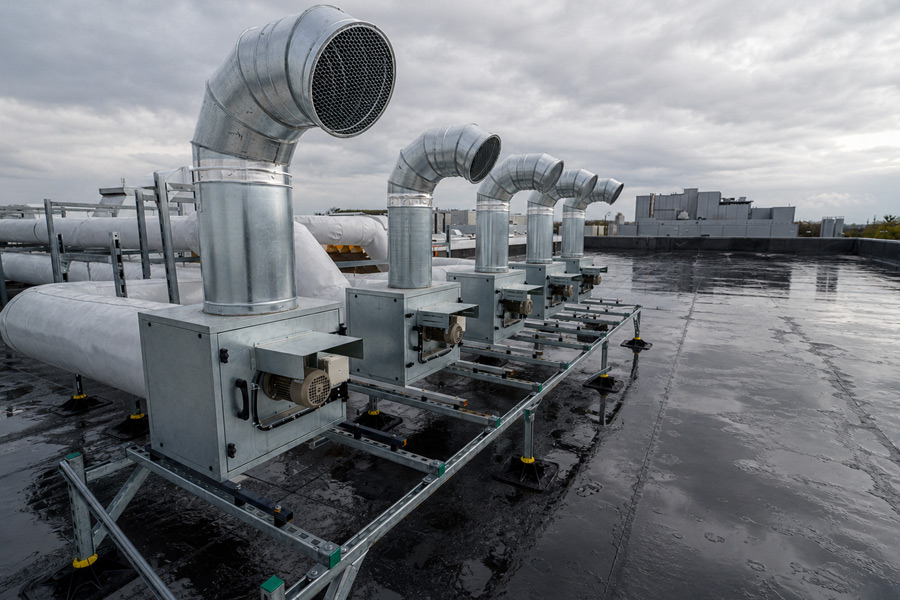
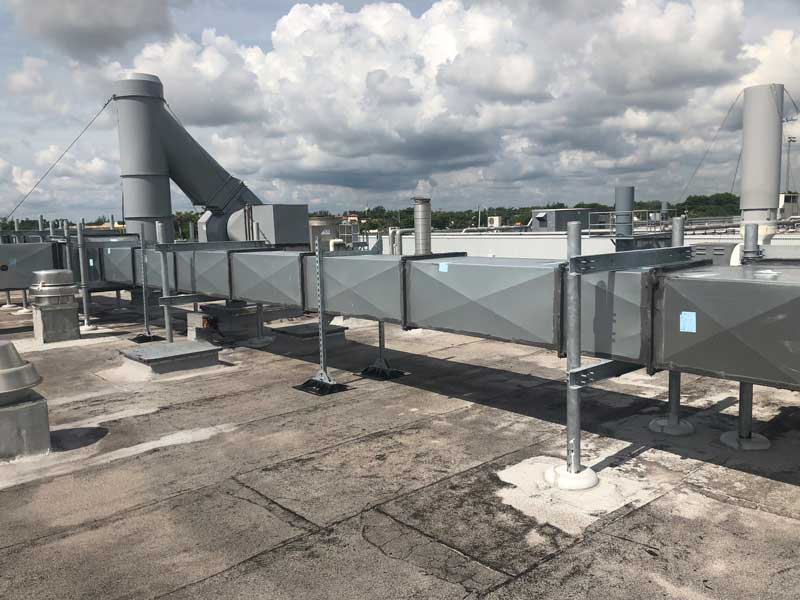
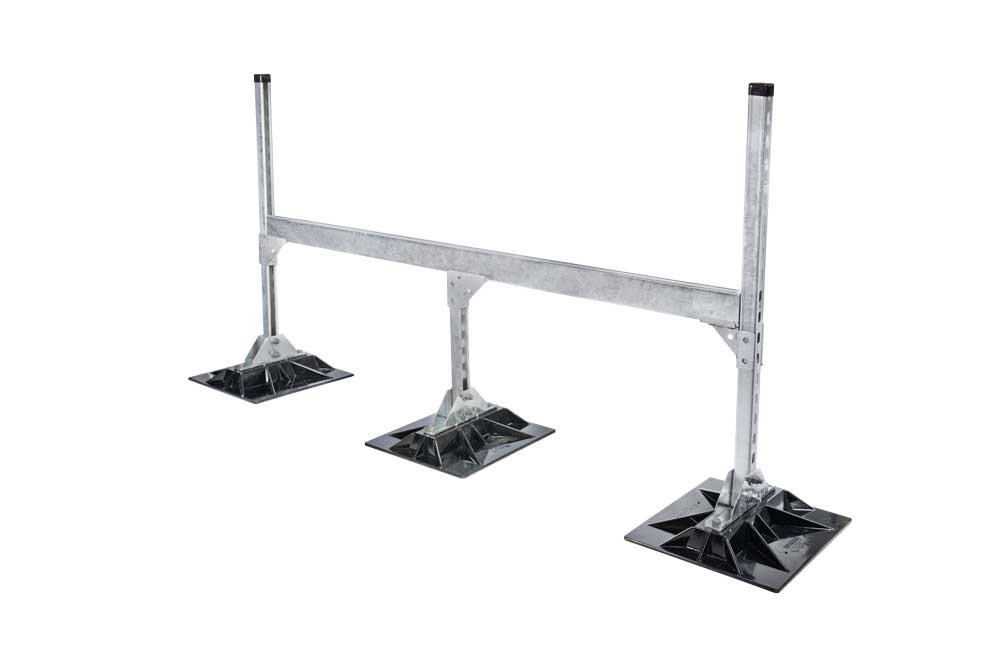
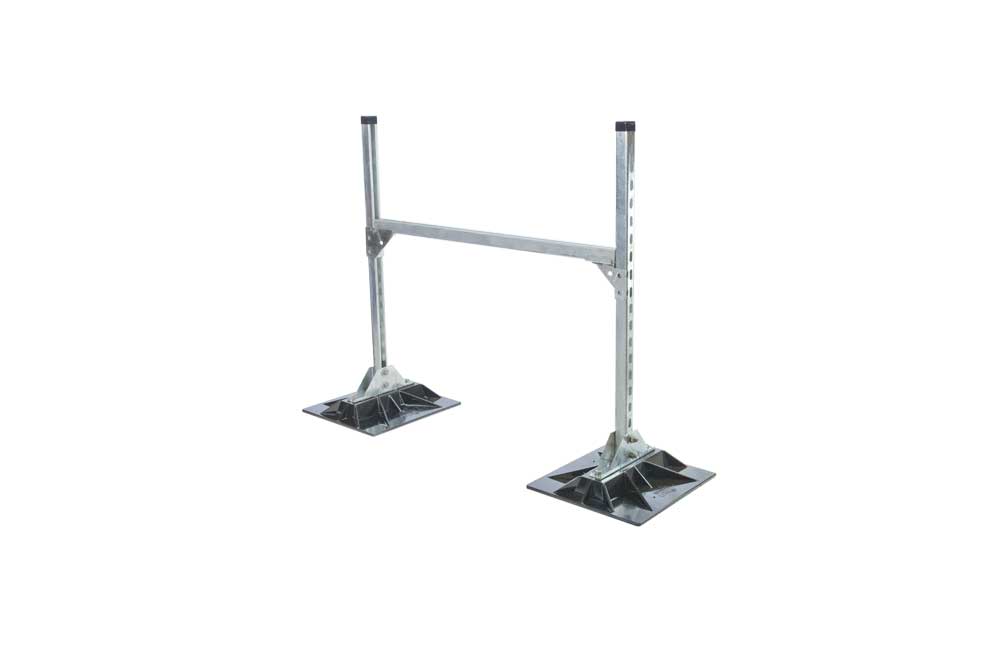
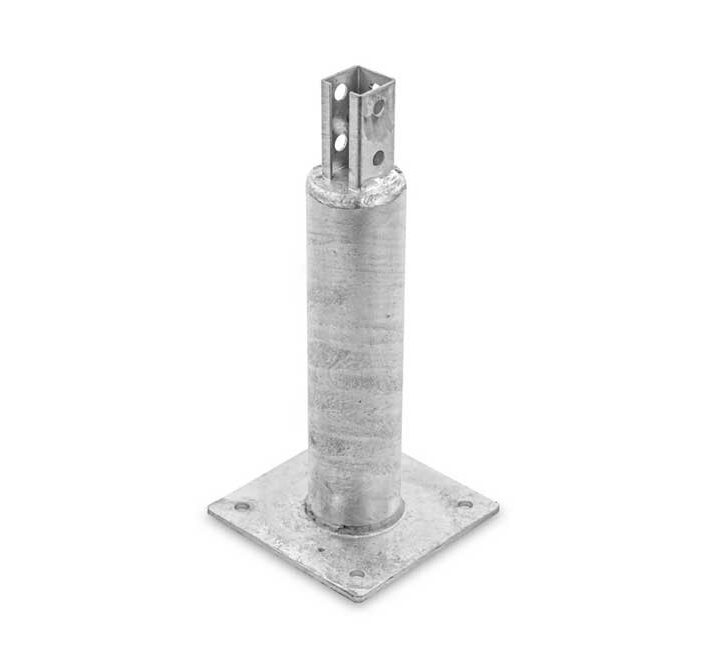
No. As a MIRO Industries roof support distributor, TCG knows that code-compliant wind and seismic supports must be positively attached to the structure, but roof penetrations are often not needed at every support point. Engineered stanchion bases and bracing tie the system back to structural members or the building perimeter at selected locations.
That arrangement splits the work three ways, and schedules are won or lost in the handoffs:
- The MEP engineer sets the design criteria for the duct system.
- Rooftop duct/support engineers design the support system, calculate support size and spacing, and provide a sealed calculation package and submittal.
- The structural engineer of record confirms the building can take the reactions where the bracing attaches, and the authority having jurisdiction has the final word.
If nobody starts that exchange until the duct is on the truck, the roof waits.
When Do Rooftop Ducts Need Seismic Restraint?
It depends on the building’s Seismic Design Category, A through F, which the engineer of record assigns from risk category, site soil, and mapped ground motion. ASCE 7-22 Chapter 13 exempts many mechanical components in lower categories and offers size- and weight-based exceptions for some ductwork, but those exceptions have firm limits.
They do not apply to duct carrying toxic, highly toxic, or flammable gases, or to duct used for smoke control. Even exempt duct connects to equipment that may move differently, so flexible connections at rooftop units and clearance from neighboring pipe and conduit need to be considered.
You may think this is all a California problem, but it’s not. The Pacific Northwest, Utah’s Wasatch Front, the New Madrid region around Memphis and St. Louis, the Charleston area, Alaska, and Hawaii all carry meaningful seismic requirements, and hospitals and other essential facilities raise the bar wherever they are built. A Pennsylvania contractor who bids a Memphis job inherits Memphis’s seismic design, not the home office’s.
Industrial Exhaust: When What’s Inside the Duct Changes the Rules
Process and industrial exhaust is TCG’s home turf, and it is the duct most likely to lose those exceptions. When ductwork is designed to carry hazardous materials, the International Building Code’s special inspection provisions call for periodic special inspection of its installation and anchorage in buildings assigned to Seismic Design Categories C through F. An exhaust run on a plant roof can move from standard supports to engineered, inspected, and documented because of what flows through it.
How Can You Spot Seismic Requirements at Bid Time?
The structural general notes that carry wind design data also carry seismic design data.
- Read the seismic block for the Seismic Design Category and site class.
- Read the mechanical specification for delegated-design language on seismic restraint.
- Look for a component importance factor of 1.5, or a statement of special inspections that lists mechanical items.
Any one of those turns a catalog order into an engineered submittal. Found at bid, that is a schedule item. Found on install day, it is a delay.
Sourcing Seismic Rooftop Duct Supports with TCG and MIRO
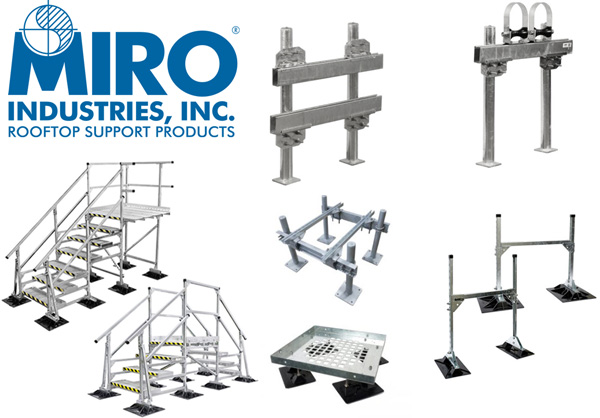
As a MIRO sourcing partner, we know MIRO offers wind- and seismic-rated options for its duct supports and many of its other rooftop products, including pipe supports, mechanical equipment supports, crossovers, platforms, and ramps. Its wind and seismic supports adjust horizontally and vertically and are available in hot-dipped galvanized or stainless steel.
MIRO has engineered rooftop supports since 1982. Its duct supports are made in the U.S.A., and the hot-dip galvanized models carry a 20-year limited warranty.
The Cincinnatus Group coordinates ductwork acquisition and the MIRO support package together, so the seismic question gets asked while the answer is still inexpensive. Behind it are 21+ years of industrial ductwork sourcing experience, a SMACNA Bronze Associate Membership, and a MIRO distributorship.
Three Challenges, One Roof
Water, wind, and seismic events present three distinct challenges. Drainage problems ask where the water goes. Wind asks what holds the duct down. Seismic asks what holds the entire HVAC rooftop system in place. A support chosen for one is not automatically right for the others, and the time to determine solutions for all three of these situations is before material ships.
Code references are to ASCE 7-22 and the International Building Code. Local amendments may modify these provisions, and project-specific design remains the responsibility of the engineer of record and the authority having jurisdiction.
At The Cincinnatus Group, we are “Called to Solve, Where Others Struggle.” Planning a rooftop scope? Contact us today at 878-295-8009 or visit www.tcgduct.com/contact to start the conversation.
Let’s start planning your next success.
To learn more about any of the services provided by The Cincinnatus Group, including Contracted Estimating and Take Offs, CAD/BIM/Coordination Drawings, and Project Management Assistance, please call us at 878-295-8009, or visit our Contact Us page today.